
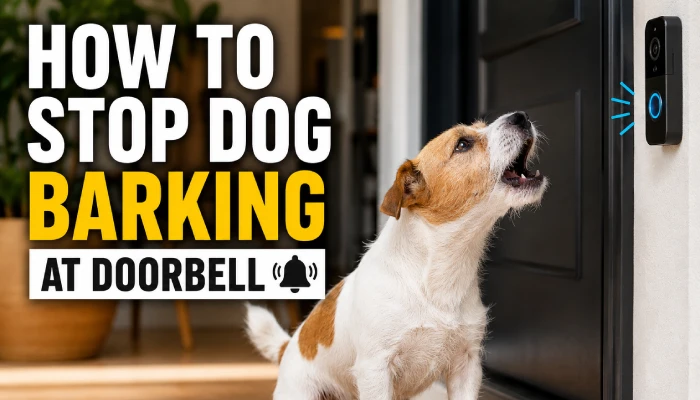
The doorbell rings.
Your dog explodes.
Barking. Lunging. Running toward the door like a furry security guard who just discovered an international crime syndicate operating on your front porch.
Sound familiar?
If you’ve searched for how to stop dog barking at doorbell triggers, chances are you’re tired of the chaos.
Maybe your dog scares visitors.
Maybe package deliveries have become embarrassing.
Maybe you’ve tried yelling, correcting, pleading, bribing, or every YouTube trick you could find.
And yet…
The second that doorbell rings, it’s like none of your training ever happened.
Here’s the good news.
This problem is fixable.
Not with gimmicks.
Not with punishment.
Not with shouting matches.
But with a simple understanding of how dogs think and how habits are created.
In this guide, you’ll learn exactly how to stop dog barking at doorbell triggers using proven training principles that create lasting behavior change.
Why Dogs Bark at the Doorbell
Most dog owners treat barking as the problem.
It’s not.
Barking is the symptom.
The real issue is the emotional response happening underneath.
Your dog hears the bell and immediately experiences:
- Excitement
- Anticipation
- Anxiety
- Protective instincts
- Territorial behavior
Just hearing that sound creates an automatic reaction.
Think of it like this.
If someone handed you $100 every time you heard a certain song, eventually hearing that song alone would make you excited.
The same thing happens with dogs and doorbells.
The sound predicts something important.
Our goal is to change that prediction.
Step 1: Stop Making the Doorbell More Exciting
This mistake is incredibly common.
The bell rings.
Your dog starts barking.
You yell:
“STOP!”
“QUIET!”
“NO!”
Unfortunately, your dog often interprets this differently than you intended.
Many dogs think:
“Excellent. My human sees the threat too.”
From your dog’s perspective, you’ve joined the barking party.
Instead:
- Stay calm.
- Move slowly.
- Avoid shouting.
- Avoid emotional reactions.
If you treat the doorbell like an emergency, your dog will too.
Step 2: Teach the “Place” Command
If there were a single skill I could teach every dog owner, it would be this one.
The Place command teaches your dog to go to a designated location and remain there calmly.
This could be:
- A dog bed
- A training mat
- A raised cot
- A crate
The objective is simple.
When the bell rings, your dog moves away from the door instead of charging toward it.
A comfortable training area can make this process much easier. Many owners use products from Pet Care Supplies to create a dedicated training space with beds, mats, and other essentials.
Practice the Place command several times daily without involving the doorbell.
Build the habit first.
Then introduce the trigger later.
Eventually your dog begins making a new association:
Doorbell = Go To Place.
Not:
Doorbell = Lose My Mind.
Step 3: Change What the Doorbell Means
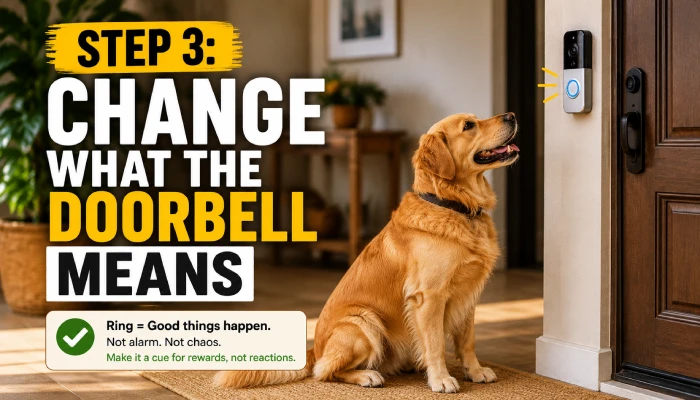
Right now, the bell predicts excitement.
We need it to predict calm rewards.
This process is called desensitization.
Here’s how it works.
- Record your doorbell sound.
- Play it quietly.
- Immediately reward calm behavior.
- Repeat multiple times.
The volume should be low enough that your dog notices it but doesn’t start barking.
Gradually increase the volume over time.
This rewires the emotional response.
One thing that dramatically improves training success is using rewards your dog actually cares about.
Many owners find that soft training treats from Pawstruck help maintain focus during distraction training and reinforce calm behavior faster.
The goal is to create a new belief:
Doorbell = Good Things Happen.
Not:
Doorbell = Intruder Alert.
Step 4: Mental Stimulation Reduces Reactive Barking
Here’s something most dog trainers won’t tell you.
Many barking problems aren’t training problems.
They’re boredom problems.
A bored dog has excess mental energy.
And that energy has to go somewhere.
Often it shows up as:
- Barking
- Chewing
- Digging
- Jumping
- Hyperactivity
That’s why enrichment matters.
Interactive toys and challenges give your dog a productive outlet for their brain.
Many owners use BarkBox because the rotating toys and activities help keep dogs mentally engaged and reduce boredom-driven behaviors.
A mentally tired dog is often easier to train than a physically tired dog.
And when your dog’s mind is occupied, the doorbell loses much of its power.
Because here’s the truth.
Most dogs can learn to stay calm when the doorbell rings.
The difference between success and failure usually comes down to consistency and having a structured training plan.
Step 5: Reward Silence More Than You Correct Barking
Most dog owners spend all their energy correcting bad behavior.
Successful trainers spend most of their energy rewarding good behavior.
Think about it.
If your dog hears the doorbell and remains quiet for three seconds, that’s exactly the behavior you want.
Yet many owners completely ignore it.
Then the dog barks and suddenly receives attention.
Your dog learns a simple lesson:
Barking gets noticed.
Instead, begin rewarding calm behavior immediately.
- Praise calmly.
- Offer a high-value reward.
- Reinforce the quiet behavior.
The more valuable the reward, the faster your dog learns.
This is another reason many trainers prefer using special rewards from Pawstruck during behavior training sessions. When rewards feel valuable, dogs pay attention.
Remember:
What gets rewarded gets repeated.
Step 6: Practice with Real Visitors
Training in a controlled environment is important.
But eventually your dog must practice in the real world.
Recruit a friend or family member.
Ask them to:
- Ring the bell.
- Wait outside.
- Leave.
- Repeat several times.
Each repetition strengthens the new habit.
The goal isn’t perfection.
The goal is improvement.
If your dog barks for thirty seconds today instead of two minutes last week, that’s progress.
Too many owners quit because they expect instant results.
Professional trainers understand that behavior change happens through repetition.
Every successful repetition becomes another brick in the foundation.
Step 7: Establish Clear Boundaries
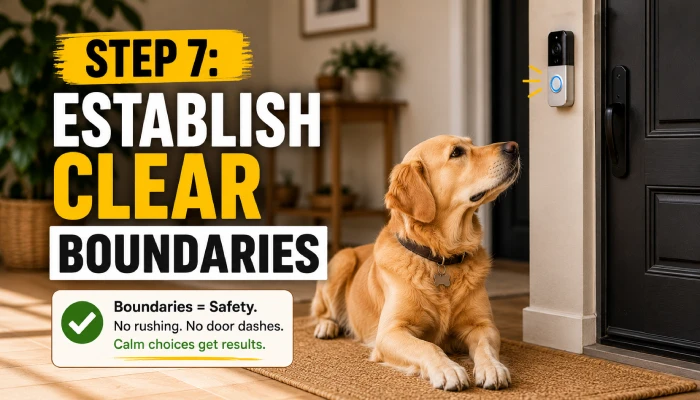
Many barking issues stem from dogs believing they are responsible for monitoring the environment.
When a dog feels responsible for security, every visitor becomes their problem.
Your job is to show your dog that you’ve got it handled.
One way to reinforce this is through clear boundaries and consistent routines.
For dogs that spend significant time outdoors, the Halo Collar can help establish consistent boundaries and reinforce appropriate behavior around property lines and visitor areas.
The goal isn’t restriction.
The goal is clarity.
Dogs thrive when they understand expectations.
The 3 Biggest Mistakes Dog Owners Make
Mistake #1: Yelling at the Dog
Let’s be honest.
If yelling worked, your dog would already be fixed.
Most barking dogs have heard plenty of yelling.
Yet the behavior continues.
Why?
Because yelling often increases excitement.
Your dog hears noise, movement, and emotional energy.
Exactly the ingredients that fuel barking.
Stay calm instead.
Mistake #2: Inconsistency
Imagine if traffic lights worked only sometimes.
Driving would be chaos.
Dogs feel the same confusion when rules change daily.
If barking is tolerated sometimes and corrected other times, learning slows dramatically.
Consistency creates confidence.
Make sure every member of the household follows the same rules.
Mistake #3: Ignoring Mental Exercise
Many owners focus exclusively on physical exercise.
Walks are wonderful.
But mental stimulation matters just as much.
This is why enrichment tools, puzzle toys, and activities from BarkBox can be so valuable.
When dogs use their brains regularly, they often become calmer and more responsive.
Support Training with the Right Tools
Training becomes easier when you have the right resources.
Many owners use Chewy to stock up on puzzle toys, treat pouches, enrichment products, and everyday training supplies.
Consistency is easier when everything you need is readily available.
You can also find useful beds, crates, mats, and routine-care items through Pet Care Supplies to support your training setup at home.
The Complete Solution: Brain Training for Dogs
If you’ve been struggling with barking, jumping, chewing, pulling, or ignoring commands, there is one resource I recommend more than almost any other. Brain Training for Dogs. This program was created by professional dog trainer Adrienne Farricelli.
What makes it different is that it focuses on how dogs learn.
Most training programs try to suppress unwanted behavior.
Dogs ‘ training focuses on developing self-control, focus, patience, and problem-solving abilities.
That’s important because excessive doorbell barking is rarely just a barking problem.
It’s usually an impulse-control problem.
When dogs learn to think before reacting, behavior changes become much easier.
The program walks owners through step-by-step exercises that build lasting habits rather than temporary fixes.
If you’ve tried random tips and YouTube videos without success, a structured system like Brain Training for Dogs can help bring everything together.
Don’t Overlook Nutrition

Here’s something many dog owners never consider.
A dog’s ability to focus, learn, and remain calm can be influenced by overall health and nutrition.
While nutrition alone won’t solve barking problems, it can support better energy levels and more effective training sessions.
Many owners choose high-quality options such as Just Food For Dogs, Wild Earth, The Pets Table, or Health Extension to support overall wellbeing.
When dogs feel their best, training often becomes easier.
Benefits of Brain Training for Dogs
- Improves impulse control.
- Helps reduce excessive barking.
- Builds focus and attention.
- Strengthens owner-dog communication.
- Provides structured step-by-step lessons.
- Uses positive reinforcement methods.
- Suitable for puppies and adult dogs.
- Addresses root causes instead of symptoms.
- Can be completed from home.
- Creates long-term behavioral improvement.
Frequently Asked Questions
Can doorbell barking be completely eliminated?
In many cases, yes. While some dogs may always notice the sound, most can learn to respond calmly instead of barking excessively.
How long does it take to stop a dog from barking at the doorbell?
Many owners notice improvement within a few weeks. Long-standing habits may require several months of consistent practice.
Should I use punishment to stop barking?
Punishment often increases anxiety and can create new behavior problems. Positive reinforcement methods generally produce better long-term results.
Does mental stimulation really help with barking?
Absolutely. Mental exercise reduces boredom, improves impulse control, and helps dogs remain calmer when triggers occur.
Conclusion
The solution to doorbell barking isn’t yelling louder.
It’s teaching a better response.
By rewarding calm behavior, practicing realistic scenarios, creating clear boundaries, and providing proper mental stimulation, you can dramatically reduce excessive barking.
Most importantly, stay consistent.
Dogs learn through repetition.
Every calm response brings your dog one step closer to becoming the relaxed companion you want.
If you’d like a complete step-by-step system designed to improve focus, self-control, and behavior, learn more about Brain Training for Dogs.
Your dog—and your doorbell—will thank you.