

Bringing home a puppy is exciting. One day they’re small enough to fit in one hand, and before you know it, they’re racing through the house, chewing everything in sight, and testing every rule you’ve tried to teach them.
If you’re wondering whether your puppy’s behavior is normal, you’re not alone.
Understanding puppy growth stages is one of the most important things any dog owner can learn. Every stage of development brings physical changes, emotional growth, and new behavioral challenges. When you know what to expect, you can stop guessing and start helping your puppy become a calm, confident, and well-behaved adult dog.
In this guide, you’ll learn each puppy growth stage, what happens during every phase, common mistakes to avoid, and how the right training tools can make the journey much easier.
Why Understanding Puppy Growth Stages Matters
Many owners think their puppy is “being stubborn.” Usually, that’s not true. Your puppy is simply growing. Just like children, puppies experience rapid changes in their brain, body, hormones, confidence, and learning ability. The methods that work for an 8-week-old puppy often won’t work for a 6-month-old adolescent. The owners who enjoy raising their puppies aren’t necessarily lucky. They simply understand what stage their puppy is going through—and they adjust accordingly.
Step-by-Step Guide to Puppy Growth Stages
Step 1: The Neonatal Stage (Birth to 2 Weeks)
This is the very beginning of life.
During this period, puppies:
- Cannot see or hear
- Sleep almost all day
- Depend completely on their mother
- Nurse frequently
- Begin developing basic senses
At this stage, breeders focus on keeping puppies warm, healthy, and well-fed.
Although owners usually don’t bring puppies home this early, this period plays an important role in long-term health and emotional development.
Step 2: The Transitional Stage (2 to 4 Weeks)
Everything begins changing quickly.
Puppies now:
- Open their eyes
- Begin hearing sounds
- Start walking
- Learn to interact with littermates
- Become curious about the world
This is when the brain develops rapidly.
Simple experiences during this stage help shape future confidence.
Gentle handling, exposure to everyday sounds, and interaction with siblings all contribute to healthy emotional development.
Step 3: The Socialization Stage (4 to 12 Weeks)
Many trainers consider this the most important stage of all.
Your puppy becomes like a sponge.
Everything they experience now teaches them what is safe—or dangerous.
 Step 3: The Socialization Stage (4 to 12 Weeks)
Many trainers consider this the most important stage of all.
Your puppy becomes like a sponge.
Everything they experience now teaches them what is safe—or dangerous.During this stage, introduce your puppy to:
- Different people
- Children
- Friendly dogs
- Various environments
- Household noises
- Car rides
- Grooming
- Gentle handling
Positive experiences now help prevent fear later.
This is also the perfect time to begin teaching:
- Sit
- Come
- Stay
- Name recognition
- Potty training
- Crate training
- Walking on a leash
Short training sessions work best because puppies have limited attention spans.
Step 4: The Juvenile Stage (3 to 6 Months)
This is where many owners begin feeling overwhelmed.
Your cute little puppy suddenly becomes:
- More energetic
- More confident
- More curious
- More independent
Chewing increases dramatically because adult teeth begin replacing baby teeth.
You may also notice:
- Jumping on people
- Stealing shoes
- Chasing moving objects
- Barking more often
- Testing household rules
Don’t assume your puppy is trying to dominate you.
They’re simply learning boundaries.
Consistency matters more than punishment.
Reward the behaviors you want.
Ignore or redirect behaviors you don’t.
Step 5: Adolescence (6 to 18 Months)
If you’ve ever heard someone say,
“My puppy forgot everything I taught them,”
this is usually the stage they’re talking about.
Hormones begin affecting behavior.
Many puppies suddenly:
- Stop listening
- Ignore recall commands
- Become distracted outdoors
- Pull on the leash
- Bark more
- Challenge household routines
This phase frustrates many owners because it feels like training stopped working.
Actually, your puppy is entering the canine equivalent of the teenage years.
Continue training.
Stay patient.
Avoid giving mixed signals.
The habits you reinforce during adolescence often become lifelong behaviors.
Step 6: Young Adult Stage (12 to 24 Months)
By now, your puppy begins settling emotionally.
Most dogs become:
- Better listeners
- More predictable
- Easier to train
- Less destructive
- More emotionally stable
Energy levels remain high in many breeds, but mental maturity finally starts catching up.
Daily exercise, structured routines, and regular training continue strengthening good habits.
Remember:
Physical maturity doesn’t always mean emotional maturity.
Large breeds often continue developing until two years of age.
Step 7: Adulthood
Congratulations.
If you’ve invested time during every puppy growth stage, you’ll likely enjoy a dog that is:
- Confident
- Well-socialized
- Calm
- Easier to manage
- Happy around people
- Responsive to commands
Good adult dogs aren’t born.
They’re developed through thousands of small, consistent moments.
Common Mistakes During Puppy Growth Stages
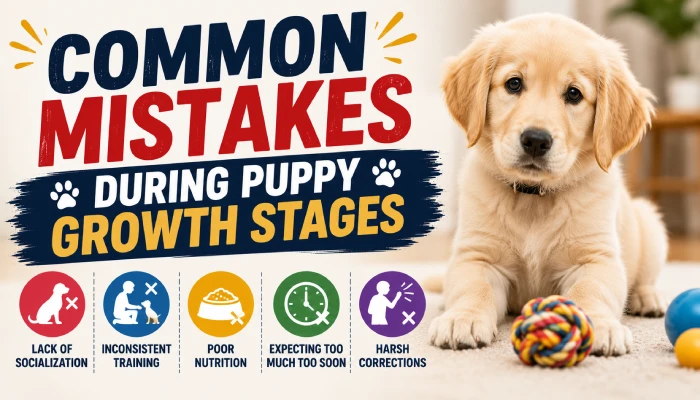
Even loving owners accidentally create problems.
Here are three of the biggest mistakes.
1. Waiting Too Long to Start Training
Many people think:
“I’ll train them when they’re older.”
Unfortunately, puppies begin learning from the first day they arrive home.
If you’re not teaching them, they’re teaching themselves.
2. Inconsistent Rules
Allowing your puppy on the couch one day…
Then scolding them the next…
Creates confusion.
Dogs learn through repetition.
Everyone in the household should follow the same rules.
3. Ignoring Mental Exercise
Most owners focus only on physical exercise.
But mental stimulation is equally important.
A mentally tired puppy is usually calmer, less destructive, and easier to train.
Puzzle games, short training sessions, scent work, and problem-solving activities all help reduce unwanted behaviors.
A Training Program That Grows With Your Puppy
Every puppy goes through predictable developmental stages.
The challenge isn’t knowing they’ll happen.
The challenge is knowing exactly what to do when they happen.
That’s why many experienced dog owners recommend Brain Training for Dogs.
Learn more here:
Brain Training for Dogs: https://dogcareandtraining.com/brain-training
Unlike training programs that rely on punishment or endless repetition, this structured system teaches you how dogs naturally learn.
Created by Adrienne Farricelli, a professional CPDT-KA certified dog trainer, the program walks owners through step-by-step exercises that match a dog’s learning ability while strengthening communication and trust.
Whether you’re raising an 8-week-old puppy or managing an energetic adolescent, the lessons help address common issues like:
- Excessive barking
- Chewing
- Jumping
- Not listening
- Poor focus
- Hyperactivity
- Lack of impulse control
Instead of trying random advice from dozens of YouTube videos, you’ll have a structured roadmap that grows with your puppy.
Products That Can Support Every Growth Stage
Training works best when combined with consistent daily routines.
Depending on your puppy’s age, these resources may also help:
- Halo Collar – https://dogcareandtraining.com/halo-collar
Helps reinforce outdoor boundaries and supports safer adventures as your puppy gains confidence. - BarkBox – https://dogcareandtraining.com/bark-box
Provides mentally stimulating toys and activities that reduce boredom during high-energy growth stages. - Pawstruck – https://dogcareandtraining.com/pawstruck
Training treats make rewarding good behavior easier and more consistent. - Just Food For Dogs – https://dogcareandtraining.com/just-food-for-dogs
Balanced nutrition supports healthy growth, energy, and learning. - Chewy – https://dogcareandtraining.com/chewy
Makes it easy to maintain consistent routines with food, supplies, and training essentials.
Benefits of Brain Training for Dogs
If you’re looking for one resource to guide you through every puppy growth stage, here’s why many owners choose it:
- Step-by-step training that’s easy to follow
- Designed by a certified professional dog trainer
- Helps reduce common puppy behavior problems
- Uses positive, reward-based methods
- Builds confidence and focus
- Strengthens communication between owner and dog
- Suitable for puppies and adult dogs
- Helps create long-term good habits instead of temporary fixes
Ready to Raise a Well-Behaved Puppy?
Your puppy won’t stay little forever.
Every day is shaping the adult dog they’ll become.
If you want clear guidance instead of guessing, Brain Training for Dogs provides a structured system you can follow from puppyhood through adulthood.
Learn more here: 👉 https://dogcareandtraining.com/brain-training
The earlier you begin, the easier it is to build lifelong good habits.
Frequently Asked Questions
At what age do puppies grow the fastest?
Puppies usually experience their fastest growth between 2 and 6 months of age. Small breeds mature more quickly, while large and giant breeds continue growing for up to two years.
When should I start training my puppy?
Training can begin as soon as your puppy comes home, usually around 8 weeks of age. Keep sessions short, positive, and fun.
Why does my puppy suddenly stop listening around six months?
Around six months, many puppies enter adolescence. Hormonal changes and increased independence often make them more distracted. Consistent training and patience are essential during this stage.
How can I keep my puppy mentally stimulated?
Short training sessions, puzzle toys, scent games, food-dispensing toys, and structured learning activities all provide valuable mental exercise. Programs like Brain Training for Dogs offer guided exercises that challenge your puppy’s mind while improving behavior.
Conclusion
Understanding puppy growth stages helps you recognize what’s normal, respond appropriately, and build better habits from the beginning.
Remember these key points:
- Every growth stage brings unique behavioral changes.
- Early socialization has lifelong benefits.
- Consistency always beats punishment.
- Mental stimulation is just as important as physical exercise.
- Structured training produces lasting results.
Raising a puppy doesn’t have to feel overwhelming. With the right knowledge and a proven training system, you can guide your dog through every developmental stage with confidence.
If you’re ready to make training easier and help your puppy grow into a well-mannered adult, check out Brain Training for Dogs at https://dogcareandtraining.com/brain-training. It provides the step-by-step guidance many new dog owners wish they had from day one.