

Bringing home a puppy is exciting.
It’s also exhausting.
One moment you’re imagining peaceful walks, cuddles on the couch, and a loyal companion by your side.
The next moment your puppy is chewing your shoes, peeing on the carpet, barking at random objects, and acting like they completely forgot their name five seconds after learning it.
If that sounds familiar, you’re not alone.
Most puppy owners don’t fail because they’re bad owners.
They fail because they don’t have a plan.
Without a structured puppy training schedule by age, it’s easy to teach the wrong lessons, create bad habits, and miss critical development windows.
The good news?
Puppies learn incredibly fast when training happens at the right time and in the right order.
In this guide, you’ll discover exactly what to focus on at each stage of puppy development so you can build confidence, obedience, and good behavior from day one.
Why Following a Puppy Training Schedule Matters
Imagine trying to teach algebra to a toddler.
It wouldn’t work because the child isn’t ready.
The same principle applies to puppies.
Every age brings different mental abilities, attention spans, and developmental needs.
🐶 Training the right skills at the right time helps:
- Prevent bad habits before they start.
- Accelerate learning.
- Reduce frustration.
- Improve obedience.
- Build confidence.
- Strengthen your bond.
Instead of reacting to problems later, you’ll be proactively shaping the dog you want.
8–10 Weeks: Building Trust and Basic Habits
Your puppy has just entered a completely new world.
Everything is unfamiliar.
This stage isn’t about strict obedience.
It’s about creating positive experiences and establishing routines.
Focus On:
- Potty training.
- Name recognition.
- Crate training.
- Handling exercises.
- Short socialization experiences.
Keep training sessions extremely short.
Think 2–5 minutes at a time.
Puppies at this age have very limited attention spans.
Creating a comfortable routine is much easier when you have the right supplies. Many owners use essentials from Pet Care Supplies to help establish consistent crate, feeding, and sleeping routines.
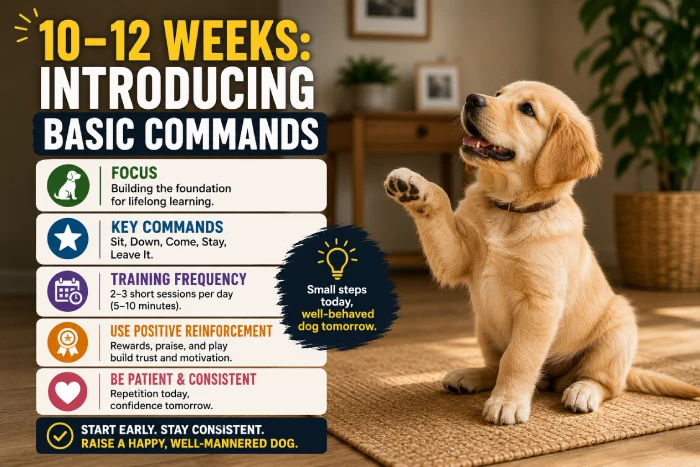
10–12 Weeks: Introducing Basic Commands
This is where training starts becoming fun.
Your puppy is becoming more aware of their surroundings and more capable of learning simple commands.
Focus On:
- Sit.
- Come.
- Down.
- Leave It.
- Leash introduction.
At this stage, rewards are everything.
You want your puppy thinking:
“Listening to my human is the greatest thing ever.”
High-value training rewards can dramatically speed up learning. Many trainers use treats from Pawstruck because they’re easy to use during frequent training sessions.
The goal isn’t perfection.
The goal is creating positive associations with learning.
3–4 Months: Socialization Becomes Critical
This period is one of the most important stages in your puppy’s life.
Experiences during this window often influence behavior for years.
Introduce Your Puppy To:
- Different people.
- Different sounds.
- Different surfaces.
- Friendly dogs.
- Car rides.
- New environments.
The objective isn’t overwhelming your puppy.
The objective is helping them realize that new things are normal.
Confident puppies often become confident adult dogs.
4–6 Months: Developing Self-Control
This is when many owners begin noticing selective hearing.
Your puppy knows commands.
They just don’t always feel like listening.
Welcome to adolescence.
Now is the time to focus heavily on impulse control.
Skills to Practice:
- Waiting at doors.
- Staying on command.
- Polite greetings.
- Walking without pulling.
- Ignoring distractions.
This is also an excellent time to introduce mental stimulation activities.
Bored puppies create their own entertainment—and owners rarely enjoy the results.
Many owners use BarkBox because the rotating toys and enrichment activities help keep growing puppies mentally engaged.
5 Essential Daily Training Habits
1. Train in Short Sessions
Five focused minutes beats thirty distracted minutes.
2. Reward What You Want
Good behavior should always be more rewarding than bad behavior.
3. Be Consistent
Mixed messages create confusion.
4. Focus on Progress
Don’t expect perfection overnight.
5. Make Learning Fun
Puppies learn best when training feels like a game.
6–9 Months: Managing the Teenage Phase
At this age, many puppies become more distracted by the world around them.
Suddenly, squirrels become more interesting than you.
Other dogs become more exciting than treats.
And commands that worked perfectly last month may seem optional.
This is normal.
Focus On:
- Reliable recall.
- Impulse control.
- Loose-leash walking.
- Ignoring distractions.
- Advanced socialization.
Think of this phase as proofing your training.
Your puppy already knows many commands.
Now they need to learn how to perform them in the real world.
Many owners also find that structured boundaries become increasingly important during this stage. For dogs spending time outdoors, the Halo Collar can help reinforce safe boundaries and encourage consistent behavior around the yard and neighborhood.
9–12 Months: Building Reliability
Your puppy is beginning to look like an adult dog.
But mentally?
They’re still learning.
This is the stage where consistency starts paying dividends.
The goal now is reliability.
Commands should work:
- At home.
- At the park.
- Around visitors.
- Near distractions.
- In new environments.
Many owners make the mistake of reducing training once their puppy starts behaving better.
Don’t.
Continue reinforcing the behaviors you want.
The habits you’re building now can last a lifetime.
Creating the Ideal Daily Puppy Schedule
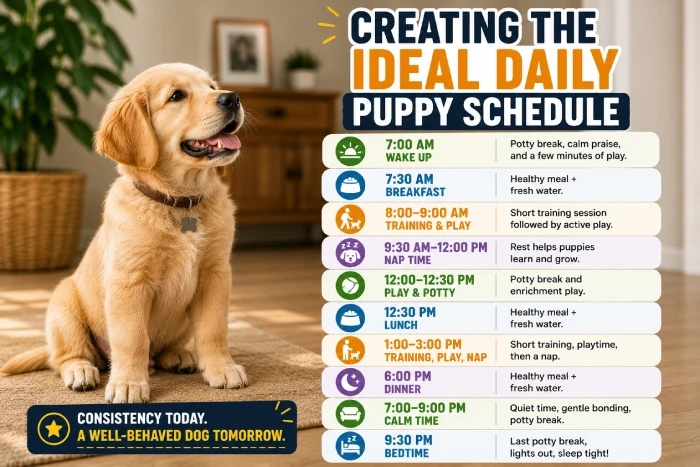
Puppies thrive on routine.
A predictable schedule helps reduce accidents, improve behavior, and speed up training.
A Sample Daily Schedule Might Include:
- Morning potty break.
- Breakfast.
- Short training session.
- Playtime.
- Nap.
- Afternoon walk.
- Mental enrichment activity.
- Evening training session.
- Dinner.
- Final potty break.
The exact schedule will vary by breed and age, but consistency is what matters most.
3 Common Puppy Training Mistakes
Mistake #1: Trying to Teach Everything at Once
Many owners overwhelm their puppies with too much information.
Remember:
Puppies learn through repetition.
Master one skill before introducing several new ones.
Mistake #2: Being Inconsistent
If jumping on guests is allowed sometimes but corrected other times, your puppy becomes confused.
Consistency creates clarity.
Clear expectations produce faster learning.
Mistake #3: Ignoring Mental Exercise
Physical exercise alone isn’t enough.
Puppies need opportunities to use their brains.
Without mental stimulation, many puppies create their own entertainment through chewing, barking, digging, or destructive behavior.
This is one reason enrichment subscriptions like BarkBox have become popular among puppy owners looking for new ways to keep growing dogs engaged.
The Complete Puppy Training Solution
If you’ve ever wished someone would simply hand you a step-by-step puppy training roadmap, you’ll want to look at Brain Training for Dogs.
The program was developed by professional dog trainer Adrienne Farricelli.
Rather than focusing solely on obedience commands, the system teaches dogs how to think, focus, and make better decisions.
That’s important because most behavior problems aren’t caused by a lack of intelligence.
They’re caused by a lack of self-control.
The program includes structured exercises designed to improve:
- Focus.
- Impulse control.
- Patience.
- Confidence.
- Problem-solving ability.
These are exactly the skills that help puppies grow into calm, reliable adult dogs.
For owners who feel overwhelmed or unsure what to teach next, Brain Training for Dogs provides a clear progression that removes much of the guesswork.
Support Training with the Right Supplies
Training becomes easier when you have the right tools available.
Many puppy owners use Chewy to stock up on training treats, puzzle toys, crates, feeders, and enrichment products that support daily training routines.
Likewise, Pet Care Supplies offers practical essentials that help make consistency easier throughout your puppy’s development.
Don't Overlook Nutrition During Training
Training isn’t only about commands.
It’s also about creating the conditions for success.
Good nutrition helps support energy levels, focus, digestion, and overall wellbeing.
Many owners choose quality nutrition options such as Just Food For Dogs, Wild Earth, The Pets Table, and Health Extension to support healthy development and consistent training performance.
While nutrition won’t replace training, it can make training more effective.
Benefits of Brain Training for Dogs
- Provides a structured puppy training roadmap.
- Builds impulse control and focus.
- Helps prevent common behavior problems.
- Uses positive reinforcement methods.
- Suitable for puppies and adult dogs.
- Easy-to-follow lessons.
- Can be completed at home.
- Improves communication between dog and owner.
- Addresses root causes of behavior issues.
- Encourages long-term success rather than quick fixes.
Ready to Raise a Better-Behaved Puppy?

If you’re serious about giving your puppy the best possible start in life, a structured training system can save countless hours of frustration.
Learn more about Brain Training for Dogs and discover how simple mental exercises can help shape a calmer, smarter, and more obedient companion.
Frequently Asked Questions
When should I start training my puppy?
You can begin basic training as early as 8 weeks old. Simple lessons like name recognition, potty training, and crate training should start immediately.
How long should puppy training sessions be?
Most puppies learn best in short sessions lasting 2–10 minutes, depending on age and attention span.
What is the most important thing to teach a puppy first?
Potty training, name recognition, recall, and socialization should be top priorities during the first few months.
How often should I train my puppy each day?
Several short sessions throughout the day are typically more effective than one long session.
Conclusion
A successful puppy training schedule by age isn’t complicated.
It’s consistent.
Focus on the right skills at the right time, keep sessions short and enjoyable, and prioritize both mental and physical development.
The effort you invest during your puppy’s first year will shape their behavior for years to come.
And if you’d like a proven step-by-step system that removes the guesswork, check out Brain Training for Dogs to help your puppy grow into the well-behaved companion you’ve always wanted.